\n
Hi, I’m Michelle.

I help people understand culture so they can connect better.

Intercultural Communication Specialist · Trainer · Facilitator

I work with professionals, organizations, expatriates, and families who need to communicate, work, and live effectively across cultures. My goal is to make intercultural learning practical, human, and immediately useful.

English & Spanish · Virtual, U.S.-based, and international programs
Michelle Masella
Michelle MasellaIntercultural Communication Specialist
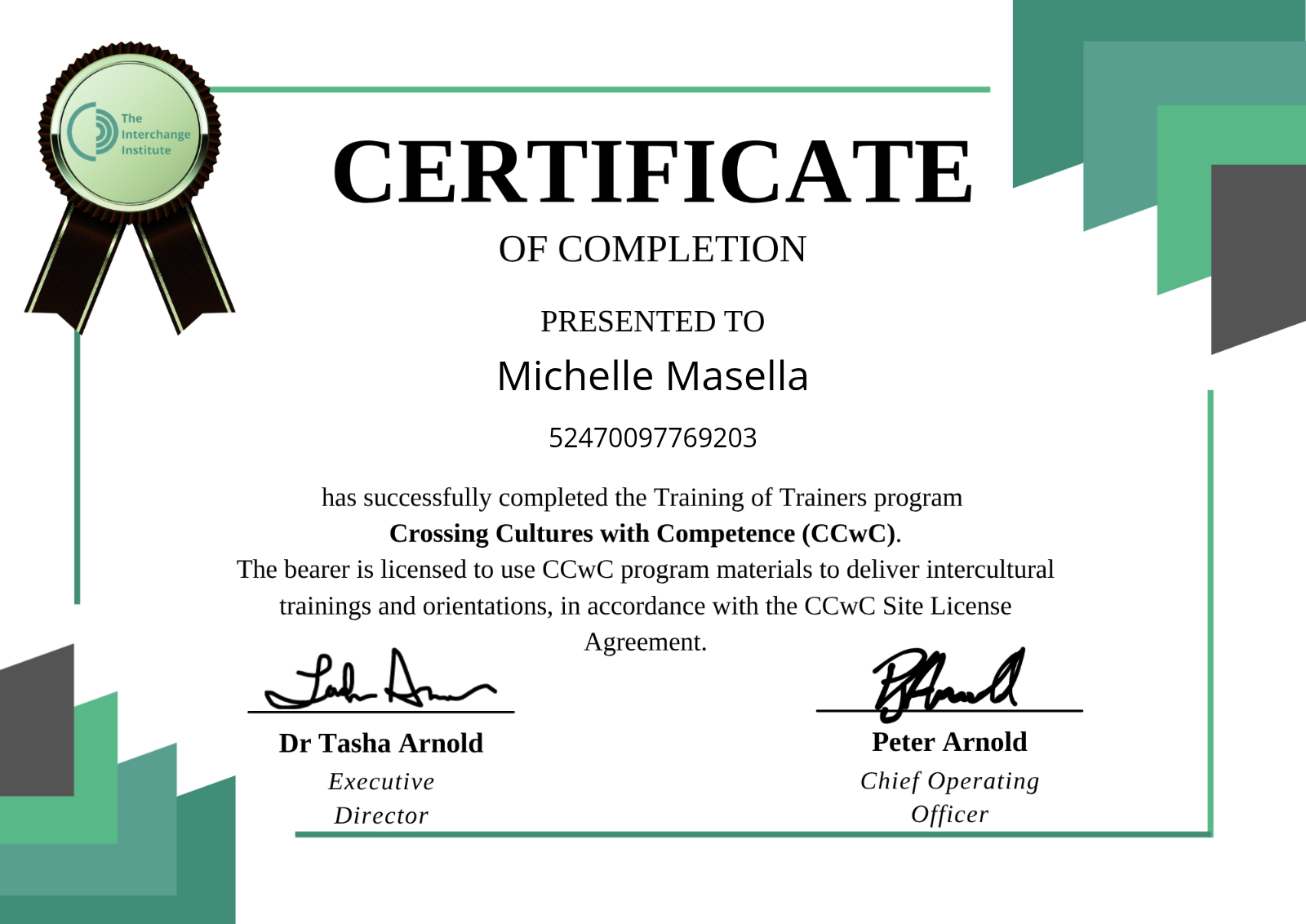
✓ CCwC certified

Awareness. Curiosity. Connection.

That’s the heart of my work. Awareness helps us notice the cultural lens we bring. Curiosity gives us alternatives to quick judgment. Connection is what becomes possible when we understand each other more fully.

How I can help

Ways to work with me.

Every engagement starts with your actual situation—who is involved, what cultures are in the room, what isn’t working, and what a better outcome would look like.

01 · Core service

Intercultural Communication Training

Interactive training for professionals and groups who want to communicate more effectively across cultural differences.

  • Communication styles and expectations
  • Hierarchy, trust, feedback, and decision-making
  • Verbal and nonverbal differences
  • Preventing and repairing misunderstandings
Custom workshops · Virtual or in person
02

International Assignment Support

Personalized cultural preparation for individuals and families before, during, or after an international move.

  • Cultural transition and adjustment
  • Workplace and daily-life orientation
  • Family adaptation
  • Repatriation perspectives

When useful, I can also connect clients with trusted local experts and guides who can offer practical, on-the-ground insight.

Individuals · Couples · Families
03

Country & Culture Briefings

Focused preparation for professionals doing business in, working with, or relocating to a specific cultural context.

  • Country-specific expectations
  • Business and social norms
  • Communication and relationship building
  • Practical scenarios

I often invite local experts to join selected briefings, share lived perspective, and answer participants’ questions directly.

Tailored to the country and audience
I know what it feels like to arrive somewhere and realize that the rules you thought were universal… aren’t.
That experience is one reason I teach intercultural communication the way I do.
A little about me

This work is personal to me.

I didn’t discover intercultural communication only in a classroom. I lived it.

I grew up in Spain and later spent sixteen years living and working in Japan and China. Across those experiences, I learned firsthand how easily good intentions can be misread when people are operating from different assumptions about communication, hierarchy, time, trust, politeness, relationships, and work.

Professionally, my career has moved across education, global mobility, language services, training, and cross-cultural facilitation. I’ve trained international educators, supported expatriates and families through relocation, worked across multicultural teams, and facilitated communication in medical, immigration, business, education, public-sector, and international event settings.

Today, through Curious Context, I bring those worlds together: structured intercultural frameworks, real-life experience, and practical conversations that help people see situations differently and choose more effective ways to respond.

16 yearsliving & working in Japan and China
35+countries traveled
EN · ESnative English and Spanish
ZHconversational Mandarin

My approach

Awareness. Curiosity. Connection.

I don’t teach culture as a list of rules. I help people build the habits that make them more effective when the cultural context changes.

01

Awareness

We start by noticing our own cultural lens—our preferences, assumptions, and automatic interpretations.

02

Curiosity

Instead of deciding too quickly what someone’s behavior means, we explore context and ask better questions.

03

Connection

We turn that awareness into practical communication choices that make trust, clarity, and collaboration more likely.

Credentials & experience

Professional training. Real-world perspective.

My CCwC credential adds a structured intercultural methodology to decades of international experience and cross-cultural communication work.

Crossing Cultures with Competence (CCwC)Verified intercultural training credential
B.A. International & Global StudiesUniversity of Central Florida · Cultural Anthropology minor
National Board Certified Medical InterpreterProfessional experience communicating across language and culture in high-stakes settings
Verify my CCwC credential
Who I work with

People navigating difference.

You may be preparing for an international assignment, leading across cultures, working with global clients, or simply trying to understand why communication that works in one context falls flat in another.

International assignees & familiesGlobal professionalsMulticultural teamsPeople leaders & managersEducation & universitiesHealthcare organizationsGlobal mobility teamsClient-facing professionals
A good fit if…

You want practical insight, not stereotypes.

  • You’re dealing with a real cross-cultural challenge.
  • You want tools you can use immediately.
  • You value discussion, reflection, and real examples.
  • You want the training adapted to your people and context.
From the blog

Ideas for navigating culture with more context.

I write about the questions that come up in intercultural work, international moves, and everyday cross-cultural communication.

Intercultural Communication · 6 min read

Why Intercultural Communication Breaks Down — Even When Everyone Speaks the Same Language

Fluent language skills do not automatically create shared meaning. Culture shapes how we interpret directness, silence, hierarchy, trust, time, and even what counts as a “good” conversation.

Read article →
International Assignments · 7 min read

Before an International Move: 7 Cultural Questions Families Should Ask

Relocation preparation often focuses on housing, schools, paperwork, and logistics. Cultural preparation deserves a place on the checklist too.

Read article →
Country & Culture Briefings · 5 min read

Country Briefings Should Go Beyond “Dos and Don’ts”

A useful country briefing should help people interpret situations—not memorize stereotypes. Here is what I believe a strong briefing should actually do.

Read article →
Let’s talk

Tell me what’s happening across cultures.

If you’re planning a training, preparing for a move, working through a communication challenge, or exploring what intercultural support might look like, send me a note. I’d be happy to hear what you’re working on.

Start a conversation with me

Tell me who the program is for, the cultures or countries involved, and what you’d like participants to walk away with.